Ormacleit in the Western Isles, Scotland
Ormacleit Castle (Scottish Gaelic: Caisteal Ormacleit) is a ruined mansion house of the early 18th century. It is located on South Uist in the Western Isles of Scotland.
The ruined mansion is generally referred to as Ormacleit Castle, Ormiclate / Ormaclett, Ormacleit House or Ormiclate Castle.
It was built in the early years of the 18th century by Allan Macdonald, chief of Clanranald, and occupied from 1707. Macdonald was killed at the Battle of Sheriffmuir on 13 November 1715, and Ormacleit Castle is said to have burned down on the same day.
After the fire, the Clanranald seat was moved north to Nunton on Benbecula, and the castle was abandoned after less than ten years of occupation.
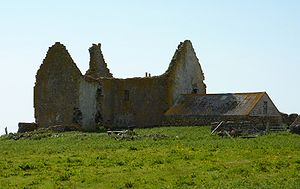
Source: Wikipedia

The meaning of 'Ormacleit'
In Scottish Gaelic, the castle is known locally as 'Caisteal Tioram'. 'Tigh' is gaelic for house, 'tye' in Old English, 'ty' in Welsh, and 'ti' in Breton all mean the same; so what we have is 'the castle of Orme's house', and it looks as though the site was known as Ormes House before the 18th century structure was built.
The Western Isles of Scotland became the home of many Norsemen who arrived between the 9th and 11th centuries. In 1098 the Western Isles officially became part of Norway under an agreement between the Norwegian King, Magnus Barefoot, and the Scottish King, Malcolm. In 1266 the Treaty of Perth returned the Western Isles and Kintyre to Scotland.
The meaning of 'Ormacleit' has been obscured by the mists of time. Using modern gaelic we can find: Orm = on me, cléit = a downy feather or a snowflake, and that would produce 'a snowflake on me'. A likely thing to happen in South Uist but an improbable place name! Allowing for spelling to change over 1,000 years, there is a similar modern word 'cleith' which means concealing or hiding - Orms hiding? Could it be Orme's hideout.